

How Ubiquinol Supports
Oxidative Balance at the Site of
Mitochondrial ROS

Not all antioxidants function in the same biological locations, and location matters. The mitochondria are the primary site of reactive oxygen species (ROS) generation in the body, and mitochondria are surrounded by a fat-rich membrane that water-soluble antioxidants cannot cross. Ubiquinol can, because it is lipid-soluble and is also created inside the mitochondrial membrane as part of the electron transport chain (ETC). Its location and continuous regeneration make ubiquinol a distinctly positioned participant in the body’s antioxidant balance.
Ubiquinol’s Position in the Antioxidant System
Ubiquinol is the body’s only endogenous lipid-soluble antioxidant.1 Its location within the mitochondrial membrane positions ubiquinol to support cellular energy production through the ETC while simultaneously neutralizing ROS at the primary point of origin during energy creation.1,2 As part of the ETC’s ongoing activity, ubiquinol is continuously regenerated within the mitochondria.2,3
Redox Cycling and Antioxidant Regeneration
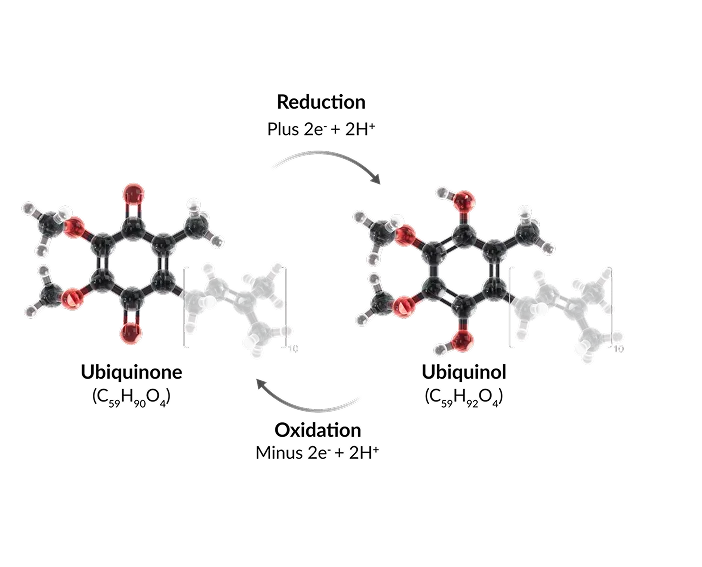
Most antioxidants are depleted in the process of neutralizing free radicals. Ubiquinol functions differently. Through redox cycling, ubiquinol and ubiquinone, the reduced and oxidized forms of CoQ10, convert continuously between states, maintaining antioxidant availability where ROS are most commonly created, and without requiring constant replacement from external sources.3,4
Ubiquinol and the Broader Antioxidant Network
The body maintains antioxidant defenses through a network of interdependent systems. Broader CoQ10 research demonstrates a supportive, systemic effect on antioxidant activity throughout the body.5 In lipid environments, ubiquinol also helps regenerate vitamin E back to its active antioxidant form, extending the functional availability of another key member of the antioxidant network.2
Age-Related Decline and Compounding Oxidative Stress
Endogenous ubiquinol production decreases with age, as the conversion of ubiquinone to ubiquinol becomes less efficient.6,7 The ratio of ubiquinol to total circulating CoQ10 shifts over time, which suggests increased oxidative stress.8 Meanwhile, external stressors from lifestyle and environmental factors can increase ROS generation, further widening the gap between ROS production and antioxidant availability.7
Bioavailability and Form
Ubiquinol’s antioxidant activity is due to its reduced form. As the active antioxidant form of CoQ10, ubiquinol requires no conversion upon absorption to perform as an antioxidant. Ubiquinone (often referred to as conventional CoQ10) must first be reduced to ubiquinol in the body before it can act as an antioxidant.9
Bioidentical to the body’s own ubiquinol, Kaneka Ubiquinol® increases plasma ubiquinol levels significantly compared to individual baseline:
- Kaneka Ubiquinol® is three times better absorbed than a conventional CoQ10 supplement.10,11
- 200 mg of Kaneka Ubiquinol® taken daily for 30 days increases plasma ubiquinol by approximately eight times compared to baseline in healthy adults,10 allowing for promotion of healthy antioxidant levels.
- Research has clearly demonstrated that supplementation with Kaneka Ubiquinol® supports healthy plasma levels and antioxidant balance.10,12

Partner With a Science-Led Ingredient Manufacturer
Kaneka Nutrients brings decades of ubiquinol expertise to antioxidant formulation. From ingredient integrity to clinical substantiation, Kaneka supports brands developing products positioned around cellular health and antioxidant balance.
We’re here to help
Frequently Asked Questions
- Bentinger M, Brismar K, Dallner G. The antioxidant role of coenzyme Q. Mitochondrion. 2007;7(Suppl):S41-50.
- Ernster L, Forsmark-Andrée P. Ubiquinol: an endogenous antioxidant in aerobic organisms. Clin Investig. 1993;71(8 Suppl):S60-5.
- Navas P, Villalba JM, de Cabo R. The importance of plasma membrane coenzyme Q in aging and stress responses. Mitochondrion. 2007;7(Suppl):S34-40.
- Martini FH. Metabolism, nutrition and energetics. In: Fundamentals of Anatomy and Physiology. 12th ed. Pearson; 2024:943-50.
- Dai S, Tian Z, Zhao D, et al. Effects of coenzyme Q10 supplementation on biomarkers of oxidative stress in adults: a GRADE-assessed systematic review and updated meta-analysis of randomized controlled trials. Antioxidants (Basel). 2022;11(7):1360.
- Kalén A, Appelkvist EL, Dallner G. Age-related changes in the lipid compositions of rat and human tissues. Lipids. 1989;24(7):579-84.
- Niklowitz P, Onur S, Fischer A, et al. Coenzyme Q10 serum concentration and redox status in European adults: influence of age, sex, and lipoprotein concentration. J Clin Biochem Nutr. 2016;58(3):240-5.
- Wada H, Goto H, Hagiwara S, Yamamoto Y. Redox status of coenzyme Q10 is associated with chronological age. J Am Geriatr Soc. 2007;55(7):1141-2.
- Kubo H, Yamamoto Y, Fujisawa A. Orally ingested ubiquinol-10 or ubiquinone-10 reaches the intestinal tract and is absorbed by the small intestine of mice mostly in its original form. J Clin Biochem Nutr. 2023;72(2):101-6.
- Hosoe K, Kitano M, Kishida H, Kubo H, Fujii K, Kitahara M. Study on safety and bioavailability of ubiquinol (Kaneka QH) after single and 4-week multiple oral administration to healthy volunteers. Regul Toxicol Pharmacol. 2007;47(1):19-28.
- Ikematsu H, Nakamura K, Harashima S, Fujii K, Fukutomi N. Safety assessment of coenzyme Q10 (Kaneka Q10) in healthy subjects: a double-blind, randomized, placebo-controlled trial. Regul Toxicol Pharmacol. 2006;44(3):212-18.
- Sabbatinelli J, Orlando P, Galeazzi R, et al. Ubiquinol ameliorates endothelial dysfunction in subjects with mild-to-moderate dyslipidemia: a randomized clinical trial. Nutrients. 2020;12(4):1098.
These statements have not been evaluated by the Food and Drug Administration.
This product is not intended to diagnose, treat, cure, or prevent any disease.
These statements have not been evaluated by the Food and Drug Administration. This product is not intended to diagnose, treat, cure, or prevent any disease.