

The heart is one of the most energy-demanding organs in the body. It relies on a continuous supply of cellular energy to function properly and stores only a very limited amount at any given time.1 To maintain its constant pumping action, the heart depends on uninterrupted energy production to support each contraction and relaxation.
Energy production, however, comes with a tradeoff. As cells generate energy, they also produce reactive oxygen species (ROS), including free radicals. If the body’s antioxidant defenses are unable to keep pace, oxidative stress can develop—an imbalance that may influence cardiovascular function over time.2 Supporting both efficient cellular energy production and antioxidant protection is a key factor in promoting long-term cardiovascular wellness.
Ubiquinol, the active antioxidant form of coenzyme Q10 (CoQ10), plays an important role in both processes. Naturally present in the body, ubiquinol supports cellular energy generation while also helping protect cells from oxidative damage.2,3
Why the Heart Requires So Much Energy
Each heartbeat depends on adenosine triphosphate (ATP), the primary energy molecule of the cell. Compared with most other organs and tissues, heart muscle cells have exceptionally high energy demands4 that sustain the repeated contractions and relaxations that drive blood circulation throughout the body.
Because the heart works continuously, cardiomyocytes—the specialized muscle cells of the heart—are highly dependent on efficient cellular energy production. If this process is disrupted, energy availability within these cells declines, which influences how effectively the heart performs over time.5
Oxidative Stress and Its Relevance to Heart Health
Oxidative stress occurs when the production of free radicals exceeds the body’s antioxidant capacity. Over time, excess ROS can affect key cellular components, including proteins, lipids, and DNA.2,6 This imbalance has been linked to several processes relevant to cardiovascular health.
 Aging, lifestyle factors, and environmental exposures can all influence oxidative stress levels. As natural antioxidant defenses decline with age, cardiovascular tissues may become more susceptible to oxidative damage.5
Understanding Ubiquinol
Ubiquinol is the active antioxidant form of coenzyme Q10 (CoQ10). While CoQ10 exists in both oxidized (ubiquinone) and reduced (ubiquinol) forms, both of which participate in cellular energy production, only ubiquinol functions directly as an antioxidant.3
Unlike ubiquinone, ubiquinol does not require conversion to provide antioxidant support.10,11
In healthy adults, ubiquinol represents approximately 95% of total circulating CoQ10 in the blood, since it is most efficiently transported in the blood in the ubiquinol form.12,13
How Ubiquinol Supports Cardiovascular Health
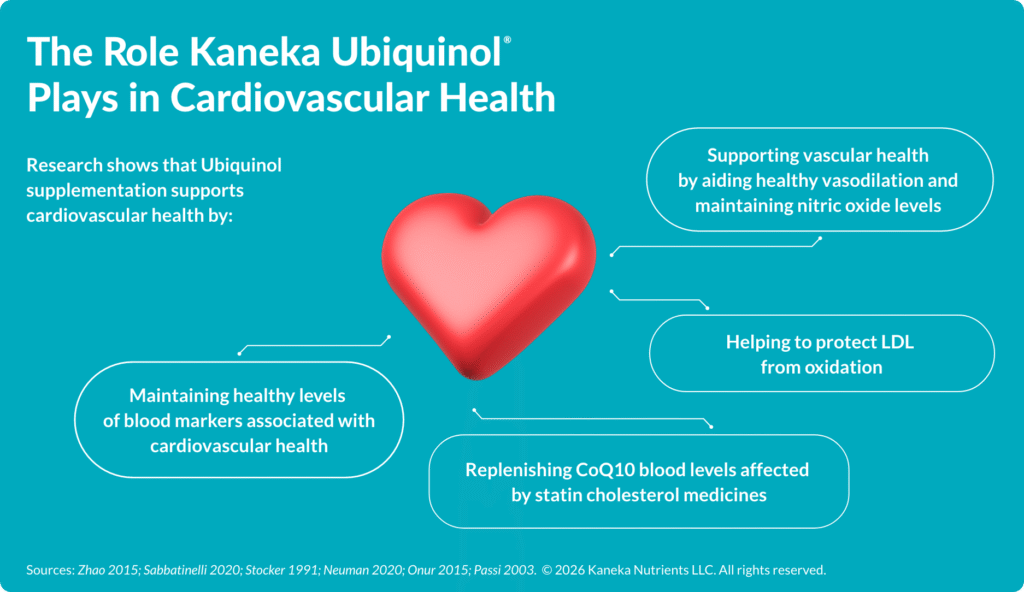
Ubiquinol supports cardiovascular health by promoting cellular energy production, providing antioxidant protection, and supporting vascular function. These processes are especially important due to the heart’s high metabolic demands and the role of vessels in transporting blood throughout the body.
Supporting Cellular Energy Production
The heart contains higher concentrations of CoQ10 than most other tissues, reflecting its ongoing need for energy. Alongside ubiquinone, ubiquinol supports efficient energy generation, helping heart cells meet the demands of continuous cardiac activity.5
Providing Antioxidant Protection
Ubiquinol is the only lipid-soluble antioxidant synthesized by the body. Its lipid-solubility positions it within the mitochondrial membrane, where it helps neutralize free radicals at the site of energy production, supporting cellular integrity in tissues with high metabolic activity, including the heart.2,3
Protecting LDL From Oxidation
In circulation, ubiquinol is primarily associated with low-density lipoprotein (LDL) with particles due to its lipid solubility. In this role, it helps protect LDL from oxidative damage, supporting normal vascular processes.10,14
Supporting Endothelial Function
Healthy blood vessels depend on (NO) to regulate vascular tone and blood flow. Ubiquinol supports normal endothelial function and vasodilation,8,10 helping to maintain vessel health.
In a randomized, double-blind, placebo-controlled clinical trial involving adults with mild-to-moderate dyslipidemia, Ubiquinol supplementation was associated with improvements in NO and vessel flexibility.10
Supporting Blood Markers Associated With Heart Health
The body’s ability to maintain ubiquinol levels naturally declines with age, particularly after age 40.15 During this time, conversion of ubiquinone to ubiquinol becomes less efficient, antioxidant capacity decreases, and oxidative stress tends to increase.
The presence or absence of certain molecules in the blood has been shown to be advantageous. Higher blood ubiquinol levels are associated with cardiovascular-related biomarkers, including C-reactive protein and GGT.16-18
Clinical research further shows that Ubiquinol supplementation improves certain cardiovascular-related blood markers and that ubiquinol status is also associated with heart health.16,19 Additional studies support the relevance of these markers as indicators of cardiovascular health.20,21
Replenishing CoQ10 Levels Depleted by Statins
Statin medications are known to reduce CoQ10 levels in the blood.22 Research shows that Ubiquinol supplementation improves CoQ10 blood levels reduced by statin cholesterol-lowering medications.23
What Sets Kaneka Ubiquinol® Apart
Kaneka Ubiquinol® is bioidentical to the ubiquinol produced naturally in the body and is supported by extensive clinical research. Its patented manufacturing process is designed to stabilize ubiquinol in its active form, ensuring purity, consistency, and reliable bioavailability.
Kaneka Ubiquinol® has been shown to be twice as readily absorbed as conventional CoQ10.24 Research demonstrates that 200 mg of Kaneka Ubiquinol® increases ubiquinol levels by approximately eight times compared to baseline in healthy adults when taken daily for at least 30 days.25
Because Kaneka Ubiquinol® delivers ubiquinol in its active antioxidant form, it is immediately available to perform its antioxidant functions without requiring conversion.10,11
- The endothelial and vascular benefits described above have been demonstrated specifically in a clinical study using Kaneka Ubiquinol®, supporting its role in promoting healthy vascular responses and endothelial function.10
- Clinical trials with Kaneka Ubiquinol® also show consistent replenishment of plasma ubiquinol levels and support for blood markers associated with cardiovascular health.10,16
Kaneka Ubiquinol®: Supporting Cardiovascular Wellness
Cardiovascular health depends on efficient energy production, balanced oxidative activity, and healthy blood vessel function. Through its dual roles in cellular energy generation and antioxidant protection, ubiquinol supports these foundational processes.
Backed by clinical research, Kaneka Ubiquinol® offers scientifically validated Ubiquinol that aligns with the physiological demands of the cardiovascular system, making it a trusted ingredient for healthcare practitioners and supplement manufacturers focused on heart health.

Related Posts

NutraIngredients – Apr 5, 2024

Nutraceuticals World - Sep 16, 2024

SupplySide Supplement Journal - Sep 20, 2024