


Kaneka Ubiquinol®
An Ally in Overall Wellness
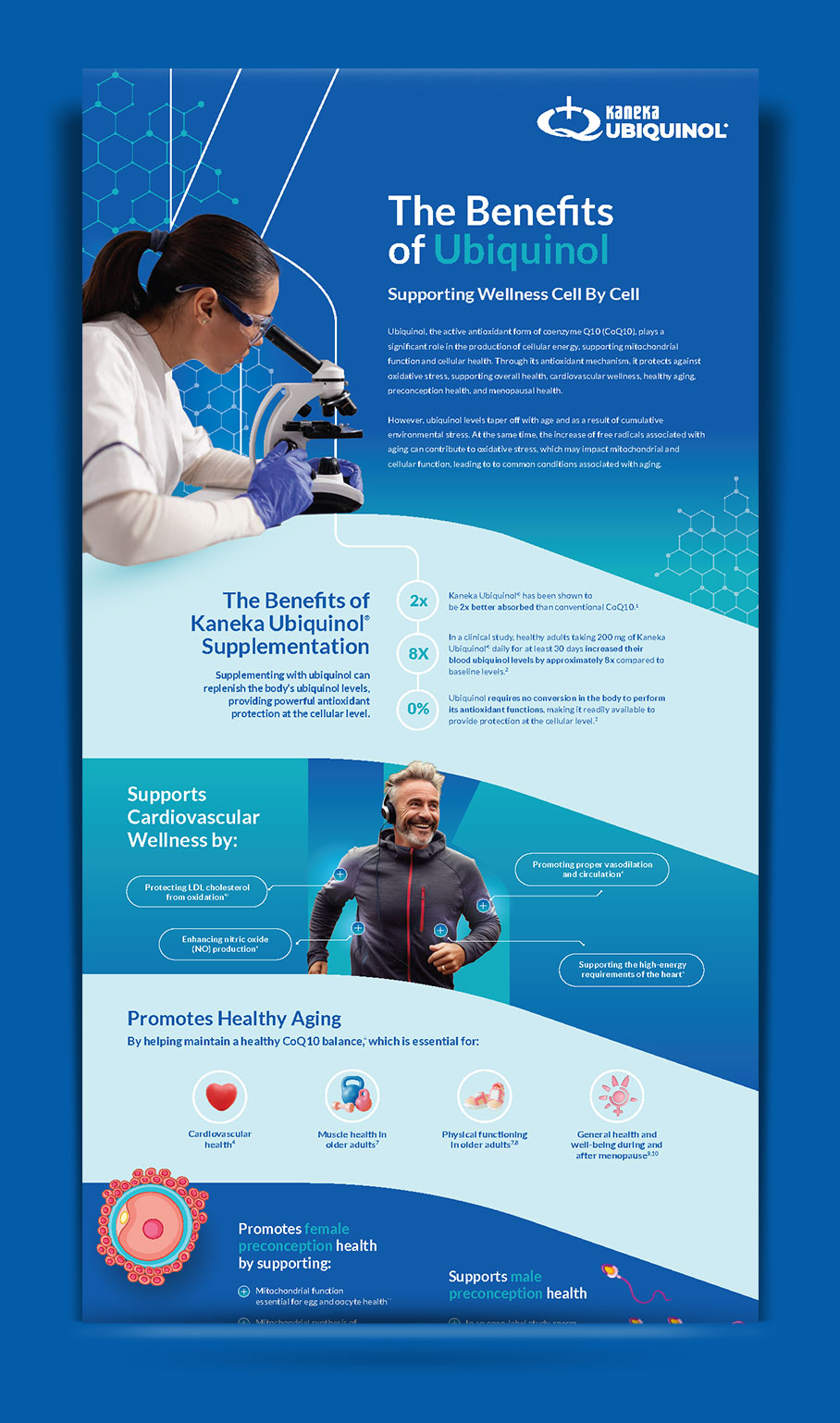
Ubiquinol, the active antioxidant form of Coenzyme Q10 (CoQ10), is found naturally throughout our bodies. It is essential for cellular function and antioxidant support, aiding physiological processes vital for overall health. With age, ubiquinol levels and antioxidant mechanisms decline, which can elevate oxidative stress, damaging healthy cells and mitochondria and leading to common age-related conditions.1,2

Ubiquinol is required for 95% of cellular energy (ATP) production.3

Kaneka Ubiquinol® is 2x better absorbed than conventional CoQ104

Research demonstrates that 200 mg of Kaneka Ubiquinol® increases ubiquinol levels by approximately 8x compared to baseline in healthy adults when taken daily for at least 30 days.5
The World’s First and Only Patented Ubiquinol Ingredient
Kaneka Nutrients is the trusted manufacturer of Kaneka Ubiquinol®, a pure, yeast-fermented Ubiquinol ingredient that is bioidentical to naturally occurring ubiquinol. It has a well-established safety profile as demonstrated by extensive clinical trial data. Kaneka Ubiquinol® is manufactured under rigorous quality controls and safety standards and is the highest quality Ubiquinol ingredient on the market.

Stabilized Kaneka Ubiquinol® Powder
Ubiquinol is prone to oxidation when exposed to air, requiring a barrier with low oxygen permeability for protection. To ensure its stability, Kaneka developed a proprietary encapsulation method utilizing fluid bed drying technology. The result is Kaneka Q30TM, a 30% concentrated powder that retains all the benefits of Kaneka Ubiquinol® in an air-stable form. It’s suitable for capsules, stick packs, nutrition bars, powdered beverages, and various solid food types. Discover how our research-to-development process supports innovative formats.
Supporting Healthy Aging Processes
With age, the body’s ubiquinol levels and antioxidant mechanisms decline and the ability to convert CoQ10 into ubiquinol diminishes, which can lead to oxidative stress and compromised mitochondrial function. Through its antioxidant properties, ubiquinol helps maintain mitochondrial health and proper function—vital for healthy aging. Clinical research demonstrates the importance of older adults maintaining adequate serum ubiquinol levels, which correlates with healthy5,6:

Cardiovascular
function6

Muscle
strength7

Physical
functioning8


Promoting Cardiovascular Health
Ubiquinol is a lipid-soluble antioxidant that is required for 95% of cellular energy production.1 Supplementation with Kaneka Ubiquinol® promotes heart health by aiding cellular energy production and providing antioxidant protection. Research demonstrates that Kaneka Ubiquinol®
- Promotes vessel health6
- Protects cells from oxidative stress9-11
- Replenishes CoQ10 blood levels depleted by statin medicines12,13
Supporting Preconception Health
Supplementation with Kaneka Ubiquinol® promotes preconception health by supporting mitochondrial function and cellular energy production and protecting reproductive cells against oxidative stress. Ubiquinol provides strong antioxidant support to neutralize oxidative stress that can affect sperm and egg quality. Studies show Kaneka Ubiquinol® further promotes male preconception health, demonstrating:
26%
improvement in sperm motility14
53%
increase in sperm count14
24%
improvement in sperm morphology15


Supporting Women’s Health Across Life Stages
Women’s cellular energy needs are shaped by reproductive biology, hormonal cycles, and menopause. These stages place physiological demands on mitochondria to manage oxidative stress and support energy-intensive functions, such as reproduction and cardiovascular health. Mitochondria play a central role in regulating homeostasis, influencing how women’s cells function, age, and sustain overall health.
Ubiquinol supports women’s health across life stages by contributing to cellular energy production, protecting against oxidative stress, and promoting mitochondrial efficiency—factors that impact healthy aging, menopausal well-being, and cardiovascular and reproductive health.
Supporting Exercise Performance
During exercise, ATP demand increases, elevating oxygen consumption and reactive oxygen species (ROS) production.16,17 While ROS play a role in training adaptations, excess levels may contribute to oxidative stress, particularly during high-intensity, prolonged, or altitude-based activity.
Kaneka Ubiquinol® supports mitochondrial energy production and antioxidant capacity during exercise, helping address the physiological demands associated with high-intensity and altitude-based activity.
Research has examined the role and effects of ubiquinol in areas related to exercise physiology, including:
- Cellular energy metabolism10,18
- Oxidative balance during strenuous activity19
- High-altitude physiological response20,21
- Physical performance in elite athletes22


KANEKA UBIQUINOL®
Backed by 30+ Years of Scientific Research
Kaneka Ubiquinol® is the subject of 100+ clinical research studies. Kaneka Ubiquinol® is a trusted brand of Ubiquinol used by researchers in clinical trials funded by the National Institutes of Health.

Get the Kaneka Ubiquinol® Advantage
With a reputation for setting the industry standard, Kaneka supports nutritional supplement and food and beverage manufacturers with the premium Ubiquinol ingredients needed to offer consumers the high-quality products they are seeking.
Partner With Kaneka Nutrients
- Bratic A, Larsson NG. The role of mitochondria in aging. J Clin Invest. 2013;123(3):951-7.
- Pallotti F, Bergamini C, Lamperti C, Fato R. The roles of coenzyme Q in disease: direct and indirect involvement in cellular functions. Int J Mol Sci. 2021;23(1):128.
- Martini FH. The cellular level of organization. In: Fundamentals of Anatomy and Physiology. 12th ed. Pearson; 2024:81-2.
- Langsjoen PH, Langsjoen AM. Comparison study of plasma coenzyme Q10 levels in healthy subjects supplemented with ubiquinol versus ubiquinone. Clin Pharmacol Drug Dev. 2014;3(1):13-7.
- Hosoe K, Kitano M, Kishida H, Kubo H, Fujii K, Kitahara M. Study on safety and bioavailability of ubiquinol (Kaneka QH) after single and 4-week multiple oral administration to healthy volunteers. Regul Toxicol Pharmacol. 2007;47(1):19-28.
- Sabbatinelli J, Orlando P, Galeazzi R, et al. Ubiquinol ameliorates endothelial dysfunction in subjects with mild-to-moderate dyslipidemia: a randomized clinical trial. Nutrients. 2020;12(4):1098.
- Fischer A, Onur S, Niklowitz P, et al. Coenzyme Q10 status as a determinant of muscular strength in two independent cohorts. PLoS One. 2016;11(12):e0167124.
- de la Bella-Garzón R, Fernández-Portero C, Alarcón D, Amián JG, López-Lluch G. Levels of plasma coenzyme Q10 levels are associated with physical capacity and cardiovascular risk in the elderly. Antioxidants (Basel). 2022;11(2):279.
- Becker WM, Deamer DW. Energy from chemical bonds: the aerobic mode. In: The World of the Cell. 2nd ed. Benjamin/Cummings; 1991;275-313.
- Ernster L, Forsmark-Andrée P. Ubiquinol: an endogenous antioxidant in aerobic organisms. Clin Investig. 1993;71(8 Suppl):S60-5.
- Forsmark-Andrée P, Lee CP, Dallner G, Ernster L. Lipid peroxidation and changes in the ubiquinone content and the respiratory chain enzymes of submitochondrial particles. Free Radic Biol Med. 1997;22(3):391-400.
- Zlatohlavek L, Vrablik M, Grauova B, Motykova E, Ceska R. The effect of coenzyme Q10 in statin myopathy. Neuro Endocrinol Lett. 2012;33(Suppl 2):98-101.
- Fedacko J, Pella D, Fedackova P, et al. Coenzyme Q(10) and selenium in statin-associated myopathy treatment. Can J Physiol Pharmacol. 2013;91(2):165-70.
- Thakur AS, Litarru GP, Funahashi I, Painkara US, Dange NS, Chauhan P. Effect of Ubiquinol therapy on sperm parameters and serum testosterone levels in Oligoasthenozoospermic infertile men. J Clin Diagn Res. 2015;9(9):BC01-3.
- Cakiroglu B, Eyyupoglu SE, Gozukucuk R, Uyanik BS. Ubiquinol effect on sperm parameters in subfertile men who have astheno-teratozoospermia with normal sperm concentration. Nephrourol Mon. 2014;6(3):e16870.
- Martini FH. Metabolism, nutrition and energetics. In: Fundamentals of Anatomy and Physiology. 12th ed. Pearson; 2024:943-50.
- Gaur P, Prasad S, Kumar B, Sharma SK, Vats P. High-altitude hypoxia induced reactive oxygen species generation, signaling, and mitigation approaches. Int J Biometeorol. 2021;65(4):601-15.
- Bentinger M, Brismar K, Dallner G. The antioxidant role of coenzyme Q. Mitochondrion. 2007;(7 Suppl):S41-50.
- Sarmiento A, Diaz-Castro J, Pulido-Moran M, et al. Short-term ubiquinol supplementation reduces oxidative stress associated with strenuous exercise in healthy adults: a randomized trial. Biofactors. 2016;42(6):612-22.
- Liu Z, Yang J, Yang B, et al. Effect of ubiquinol on electrophysiology during high-altitude acclimatization and de-acclimatization: a substudy of the Shigatse CARdiorespiratory Fitness (SCARF) randomized clinical trial. Int J Cardiol. 2024;401:131817.
- Lv H, Liu Z, Sun M, et al. Cardiorespiratory fitness and effects of ubiquinol during high-altitude acclimatization and deacclimatization: the SCARF trial. iScience. 2025;28(3):112112.
- Alf D, Schmidt ME, Siebrecht SC. Ubiquinol supplementation enhances peak power production in trained athletes: a double-blind, placebo controlled study. J Int Soc Sports Nutr. 2013;10:24.
These statements have not been evaluated by the Food and Drug Administration.
This product is not intended to diagnose, treat, cure, or prevent any disease.
These statements have not been evaluated by the Food and Drug Administration. This product is not intended to diagnose, treat, cure, or prevent any disease.